
Skip to content
  • Home
  • Archive
    • Chapters
    • Comic Pages
  • About
  • Characters
  • World
  • Support
    • Patreon
    • Store

Chapter: Chapter 7: Antlers


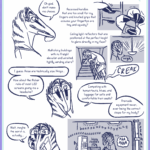
  • Napkinkat asked: Talita, what's the most annoying thing about human-designed architecture and devices for you to deal with besides size? Talita: Oh god, don't make me choose. Recessed handles that are too small for my fingers and knurled grips that assume your fingertips are tiny and squishy? Ceiling light reflectors that are positioned at the perfect height to glare directly in my face? Multistory buildings with no freight elevator and unrated, tightly winding stairs? I guess those are technically size things... How about the flicker rate of most LED screens giving me a headache? Competing with human taurs, bikes, and luggage for safe and comfortable train seats? Premade equipment never, ever being the correct shape for my body? Wait, maybe the worst is, actually... Electronics and pipes that make noise but nobody else can hear it, so I get to choose between slowly going insane or  deafening myself by wearing earbuds everywhere...

    RttS Reader Questions 26

    Sep 27, 2025

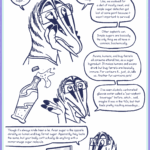
  • Talita: Oh... I can't taste sugar... It's a centaur thing. Like, we evolved for a diet of mostly meat, and simple sugar detection got lost at some point because it wasn't important to survival. Other sophonts can. Simple sugars are basically the only thing we all have in common, biochemically. Avians, humans, and bug ferrets all consume ethanol too, as a sugar byproduct. It makes humans and avians drunk but bug ferrets are basically immune. For centaurs it... just, uh, kills us. Another fun carnivore perk! I've seen alcoholic carbonated glucose water called a "pan-sophont beverage!" before, which... well, maybe it was in the 40s, but that feels pretty insulting nowadays... Though it's always kinda been a lie. Avian sugar is the opposite chirality as human and bug ferret sugar. Apparently they taste the same, but your body can't actually do anything with a mirror-image sugar molecule. Except give you the runs, I've heard. Heh.

    RttS Reader Questions 25

    Sep 25, 2025

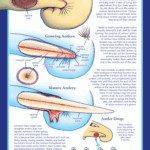
  • LOG 7.2: Centaur Antlers Although they resemble tusks, the bony growths on a centaur’s lower jaw are actually a very different structure. While tusks are solid teeth that grow continuously from a living root, antlers are hollow bones that grow annually under a layer of living skin called velvet. This skin loses sensitivity and sheds off once the antler is mature, leaving bare bone. Centaur antlers do not branch and retain some living tissue in their spongy core until they drop off their pedicle. While in Earth’s cervids antlers are a sexually dimorphic trait used for male sparring, the purpose of centaur antlers is much more ambiguous. All sexes of centaur have antlers, and while females may use them as a weapon in dominance conflicts, they’re less favored than biting and punching. Some centaurs use their antlers to root through soil for burrowing animals and tubers, but their seasonality makes them useful for only a few months out of the year. The most broadly accepted theory for their evolution is that they function as a social identifier. Centaurs do not develop antlers until puberty, and progressively grow longer sets until they reach the end of their fertility. Clan groups tend to develop their antlers at the same time, but on slightly different intervals then neighboring clans. A sick centaur may not grow antlers at all. As such, antlers can often be used to gauge the health, age, clan affiliation, and fertility of other centaurs at a glance. Centaurs have longer and straighter antlers than non-sapient members of their genus, and some xenobiologists believe this is because their antlers co-evolved with tool use. Many beads, sewing needles, blades, and leather burnishers found on the centaur home planet are made from antler bone; both in their modern day and dating back to prehistory. Many centaurs will also decorate their antlers while they're still attached to their body. Dyeing, scrimshaw, carving, jewelry, and drilled holes are all found in various cultures around their planet. While most clans either eat or discard their shed velvet, some have been known to cure the skin for use in leather crafting. Between Antlers: Image: A profile of a centaur’s snout shows one of the dark oval markings on the sides of their lower jaw. pedicle scar Growing Antlers: Image: The same profile shows the antler beginning to grow from the pedicle in cut away. The tip is full of blood vessels and gradually hardens into bone as the structure elongates. central artery skin velvet feathers (Image: An integument structure with a short, tiny quill from which a flat comb of fur-like bristles emerge on one axis, and a pair of branched downy filaments emerge on the other axis.) capillary blood vessels mesenchyme precartilage cartilage mineralized cartilage spongy bone compact bone Mature Antlers: Image: The same profile shows a cutaway of the finished bone, with velvet skin shedding off. peeling velvet exposed bone Antler Drop: Most centaurs grow their antlers in the beginning of summer or winter, and drop them after about 3 months. Image: The antler detaches from the jaw, leaving a raw red pedicle behind to heal back into the dark pedicle scar. A series of antlers shows them increasing in length with age. first set young adult adult middle-age

    Runaway to the Stars: Page 212

    Sep 23, 2025

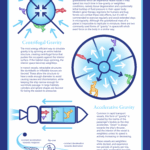
  • LOG 7.1: Simulated Gravity When you stand on a planet, its enormous mass attracts the smaller mass of your body towards its surface, while the surface resists the force gravity exerts on your body. Animals that evolve to cope with a specific gravitational force can experience health issues if they spend too much time in low-gravity or weightless conditions, namely tissue degeneration and a potentially lethal buildup of fluid pressure in their upper body. Modern gene therapy regimens for humans and bug ferrets can combat these side effects, but it's still recommended to exercise regularly and avoid extended stays in microgravity. Although the gravitational mass of a planet is impossible to replicate in miniature, there are two commonly used forms of "gravity" in spacecraft which exert force on the body in a similar way. Image: A centaur, human, avian, and bug ferret are pulled towards the center of a spherical mass and pushed back from the center by its surface. Centrifugal Gravity The most energy efficient way to simulate gravity is by spinning an entire habitat structure, creating centrifugal force that pushes the occupants against the interior surface. If the habitat stops spinning, the interior space becomes weightless. In transit vessels, retractable structures like dumbbells or inflatable toruses are favored. These allow the structure to have a wide enough diameter to avoid causing nausea and disorientation, while keeping the ship narrow enough for wormhole passage. In large habitats, cylinders and sphere shapes are favored for being the easiest to pressurize. Image: A centaur, human, avian, and bug ferret stand inside the surface of a spinning hollow circle and are pulled outwards from the center of the circle and pushed back by the interior surface. Accelerative Gravity Common in rapid transport vessels, this form of "gravity" is created by the inertia of the passenger's bodies as the ship accelerates. "Down" is always towards the ship's thruster, and the interior of the vessel is weightless unless its speed is actively increasing or decreasing. These vessels are weightless while docked, and experience two periods of gravity per trip, once while accelerating towards the destination, and once while decelerating towards the destination. Their interior spaces are designed to adapt between microgravity and weighted conditions. Image: A centaur, human, avian, and bug ferret stand inside an accelerating rocket and are pushed aft by the acceleration, and are pushed back by the floors of the rocket ship. Brachistochrone Transfer constant acceleration towards midpoint: simulated gravity pulls in the opposite direction of transit flip-over: the ship pivots to direct the thruster in the direction of transit and experiences microgravity constant deceleration towards destination: simulated gravity pulls in the direction of transit

    Runaway to the Stars: Page 211

    Sep 20, 2025

  • Talita stares at the blanket stretched between her hands, stunned into speechlessness. She finally turns back to Bip's avatar in disbelief. It's perched on the sideways door frame of one of the crew cabins that electrician worms are crawling into. Talita: You’re getting rid of it, too?? Bip: Ngilick kept the blanket alive, and they're dead. I was going to bury it with them. Talita looks down at the blanket in her hands, a terrible, bottomless, unanswerable sadness welling in her eyes.  Talita: Would it… She pulls it closer to her chest, hesitant. Talita: …Be weird if I asked to keep this? Bip's avatar moves after the worms, the sliding door threshold cutting a dark groove between the two halves of its immaterially two dimensional body. In the cabin beyond, dents and scuffs left by the previous locations of tacked down furniture trace the lives of its previous inhabitants with their absence. The avatar looks back at Talita with an odd, wistful expression. Bip: Take good care of it, Talita.

    Runaway to the Stars: Page 210

    Sep 18, 2025

  • Bip: That’s an antler velvet blanket. Talita holds up the blanket, her arms and the bottom of the artifact appearing to melt away into a series of embroidered depictions of the past crew created with the same stitches as the symbols on the real blanket. Bip: Every year, the matriarch Ngilick would help the clan carve off their loose velvet. An embroidered depiction shows two centaurs, one carving off the antler velvet with a knife. The "knife" is a pointed piece of bone with a hole on the wide end. It's punctured through the embroidery surface to go under Ngilick's hand, with the hole sewn down. The antler velvet appears to be an applique.  Bip: The raw skin would be washed in salt water and stretched to dry. An embroidered depiction shows Ngilick pinning pieces of velvet to dry, depicted as applique triangles held down by knots. Bip: The stiff dried skins were massaged with animal gland oil until they softened and cured. Ngilick would sew the panels into the blanket and embroider them with the year's events. An embroidered depiction shows Ngilick sewing pieces of the velvet onto the blanket. They hold the sewing needle with their trunk, portrayed as a real, threaded needle puncturing the embroidery surface. Bip: Some of those panels are from Ngilick's great-grandclan. They might be over 100 years old. An embroidered depiction shows a group of centaurs proudly holding up the blanket, a rectangle of tessellating applique triangles.

    Runaway to the Stars: Page 209

    Sep 16, 2025

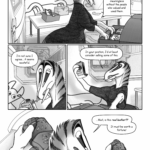
  • Talita opens the top drawer of a large chest curiously, while Bip's avatar snakes around the walls near her. Talita: Are you really getting rid of all of these… …personal possessions? Bip: Objects are meaningless without the people who valued and used them. She frowns, holding up an old, beat up manual book. Talita: I’m not sure I agree… it seems wasteful. She holds the book out arms length, squinting to try and read the text without glasses. Talita: In your position, I’d consider at least selling some of this. She reaches deeper into the drawer and touches something soft, tugging out a thick, plush fold of it with her hand. It appears to be a large blanket of tiled, fuzzy triangles. Each triangle has simple stitched designs and knots in the center, forming simple patterns and symbols. Talita pulls it closer to her face and realizes with sudden astonishment that she's touching a real organic material, not faux velvet. Talita: …Wait, is this real leather?? It must be worth a fortune!

    Runaway to the Stars: Page 208

    Sep 13, 2025

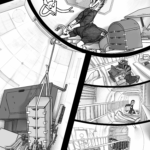
  • A montage of panels shows Talita removing furniture from the interior of the Runaway. Bracing against a door, face contorted with effort, she pulls on the moving straps to lift a cabinet that has fallen against the exterior wall of a cabin room next to a smashed and dented desk. Inside the room, the electrician worms help lift and guide the furniture so it doesn't swing and scrape against anything. The walls and floors of the wedge shaped cabins show ghostly lines of where furniture used to be attached, and people used to walk. On the floor of the interior room (which with current gravity, is a wall) Bip's avatar waves at her nervously and appears to watch her progress.  Talita adds the cabinet to her pile of removed furniture in the interior room. She carries a piece of furniture under her arm, stepping over the bulkhead dividers between the floors of the habitat module. Then she places the cabinet down carefully into the four sided docking ring room, where a pile of removed furniture is slowly growing in size.

    Runaway to the Stars: Page 207

    Sep 11, 2025

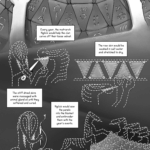
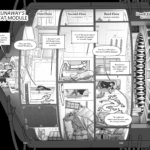
  • THE RUNAWAY'S HABITAT MODULE A cutaway shot shows Talita following the worms, exiting the docking ring and walking carefully through the lower storage room that connects the habitat module to the rest of the vessel. Bip's avatar follows, appearing to walk along the doors of the cabinets, the vector lines of their body interrupted by seams and handles as if they were a painting behind them. Bip: Sorry about the bumpy terrain, "gravity" in here isn't supposed to go sideways. First Floor: Kitchen and Commons The habitat module resembles a four story building lying on its side. Each floor's main space is a ring around the central spine and elevator shaft. The first floor contains a living space with a screen, seating areas, food preparation and storage areas, all clean and empty. It's the area that had a hole in it that Talita peered through on first her look inside the Runaway, but the spotless interior and large wall patch makes it almost unrecognizable. Talita leans over the considerable drop to the far wall of the kitchen to poke her head into the living room. Talita: Wow, you really cleaned this place up. Bip's avatar slides around the 90 degree bend between floor and wall, elongating, appearing larger than Talita. Bip: I did what I could with the electrician worms and onboard actuators. Second Floor: Crew Dormitory Talita walks through the spine, surrounded by open doors to rooms with a much messier interior. Furniture has been knocked loose and tumbled around these rooms, settling to the lowest walls were gravity has pushed it. Strangely shaped chairs, beds, handmade chests, tables, desks, and things smashed beyond recognition fill these otherwise barren rooms. Bip goes with Talita, elongating further and winding their avatar's body around the curve of the spine through multiple room floors. Bip: A lot of the heavier objects still need to be secured or removed, though. Third Floor: Passenger Dormitory Talita leans through one of the open room doors and smirks at Bip's giant avatar displayed on the wall. Talita: Are ALL of the walls in here electrowetting displays? Bip's avatar and two nearby worms strike a pose. Bip: Much classier than a tablet screen with wheels, don't you think? Talita: The tablet with wheels would be more useful for moving furniture... Fourth Floor: Bip's Servers Furthest up the spine and shielded by the thickest walls on the vessel is a command room. The thing Bip essentially is, the animator casting shadow puppets inside the walls of their own body, is a ring of 40 server boxes fixed to the upper corners of the room.

    Runaway to the Stars: Page 205 and 206

    Sep 09, 2025

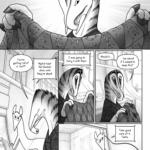
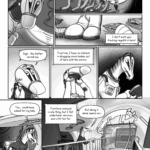
  • Talita looks around the airlock chamber, bewildered, as the interior hatch opens. Talita: Is this gas mix breathable? Bip: Yep! I pinched some O₂ from the electrolysis plant. Talita starts to walk out of the chamber, but the swarm of worms frantically rears up, grabbing her feet. Bip: HEY HEY HEY! Suit off! I don’t want you tracking regolith in here! Talita rolls her eyes and unclips the oxygen lines off her helmet so she can remove it. Talita: Sigh… this better not kill me. Bip: Trust me, I have no interest in dragging more bodies out of here with the worms. Talita finishes pulling her helmet and pauses in stunned horror, considering the implications. Slowly her shock condenses into sadness as she takes off the rest of her suit, leaving it in the airlock chamber. She steps out of the interior airlock door into the large, cross-shaped docking module room. Talita: You... could have asked for my help. Bip: Furniture removal is one thing, but I felt undertaker services was a bit too far. Talita: But doing it alone seems so— She looks at the overhead surface of the room and stops, staring. Bip's avatar climbs around the edge of the opening between the docking module and the habitat like a moving painting on the wall. The worms crawl through the opening and the avatar points for her to follow them, where lights are turning on and hatches are opening in sequence down the long elevator shaft of the spine. Bip: This way. Watch your step! Talita: ...Alright.

    Runaway to the Stars: Page 204

    Sep 06, 2025
1 2 3 4
Promotional Banner
© Jay Eaton 2025